
Search South Carolina Court Records
South Carolina court records are public documents maintained by county Clerks of Court and the South Carolina Judicial Branch. You can search court records from the Circuit Court, Family Court, Magistrate Court, Municipal Court, and Probate Court across all 46 South Carolina counties. The SC Judicial Branch Public Index provides free online access to case information statewide. This page covers where to find court records in South Carolina, how to search them, and what each type of record contains.
South Carolina Court Records Quick Facts
South Carolina Court Records Overview
Court records in South Carolina are public under state law. The right to access these records is grounded in several statutes including S.C. Code Ann. § 14-3-410, § 14-5-10, § 14-8-240, and § 14-9-150, which establish the public nature of records at every court level. The South Carolina Freedom of Information Act at § 30-4-10 et seq. also guarantees any person the right to inspect, copy, or receive an electronic transmission of any public record held by a government body in South Carolina.
The South Carolina Judicial Branch serves as the main hub for court information across the state. The Judicial Branch website provides multiple access points for different record types, including the Public Index for trial courts and C-Track for appellate courts. The site covers all court levels: the Supreme Court, Court of Appeals, Circuit Courts, Family Courts, Probate Courts, Magistrate Courts, and Municipal Courts. County-specific contact pages, court directories, and standardized forms are all available at sccourts.org. The site also includes Spanish translation options and resources for self-represented litigants in South Carolina.
The SC Judicial Branch homepage is the starting point for most court record searches in South Carolina.
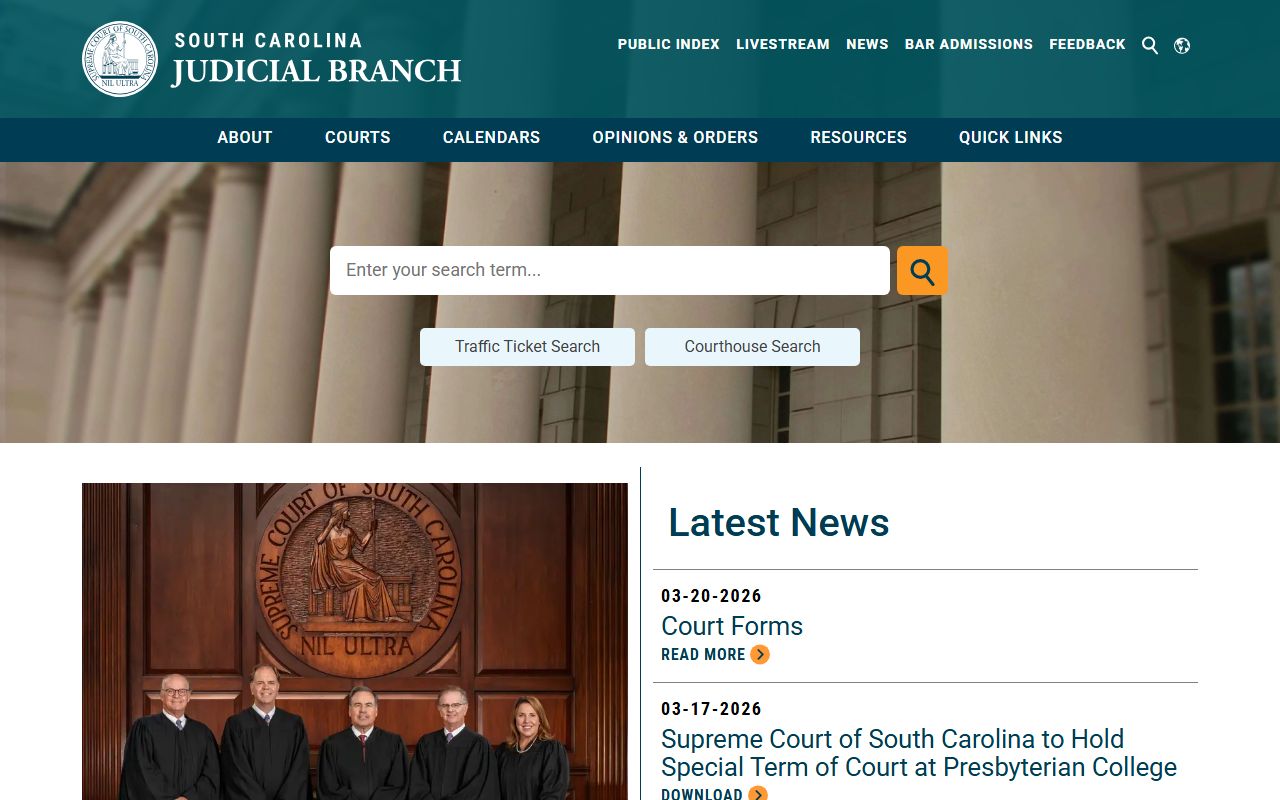
The Judicial Branch maintains court statistics including caseload data, clearance rates, and performance metrics for all court levels. Access to court opinions, Supreme Court orders, and administrative orders governing court operations statewide are all available through the same portal. The system also tracks alternative dispute resolution programs, problem-solving courts, and specialized dockets such as drug court and veterans court operating throughout South Carolina.
How to Search South Carolina Court Records
South Carolina offers several ways to look up court records. Online access through the Public Index is the fastest option for most searches. In-person visits at the county courthouse work best when you need certified copies or want to review the complete case file. Both options are available to anyone in South Carolina.
The South Carolina Judicial Branch Public Index is a collection of publicly accessible portals that provide information about state court cases. The system operates county by county, with each judicial circuit maintaining its own public index portal. To search, you select a county, accept the terms of service, and then search by party name, case number, filing date range, or case type. Results show party names, case numbers, filed dates, case status, disposition dates, case types, subtypes, and the court agency handling the matter. Clicking on a case reveals additional detail including attorneys of record, case events, and available documents. The search is free. Start at sccourts.org/case-records-search.
As of January 1, 2026, home address information no longer appears on the Public Index to protect personal privacy. Social security numbers and financial account numbers are also protected from public display under S.C. Code Ann. § 30-2-330. The Public Index requires a browser with cookies and JavaScript enabled to function properly. Some browsers may also need pop-up exceptions enabled to view case documents in South Carolina.
Note: Automated scraping or bulk downloading of Public Index data is expressly prohibited under the system terms of service for South Carolina court records.
South Carolina Court System Structure
South Carolina has a unified court system with several distinct levels. The Supreme Court and Court of Appeals handle appeals and statewide legal questions. Below those are Circuit Courts, Family Courts, Probate Courts, Magistrate Courts, and Municipal Courts. Each level handles different case types and produces different court records. Knowing the structure helps you locate the right records in South Carolina.
The state is divided into 16 judicial circuits. At least one resident circuit judge serves each circuit. Forty-nine circuit judges rotate among those 16 circuits. Court terms and assignments are set by the Chief Justice based on recommendations from Court Administration. Circuit judges are elected by the General Assembly to staggered six-year terms. All candidates must be screened and found qualified by the Judicial Merit Selection Commission before election. This rotating structure ensures that South Carolina court records across all counties are part of one coordinated statewide system.
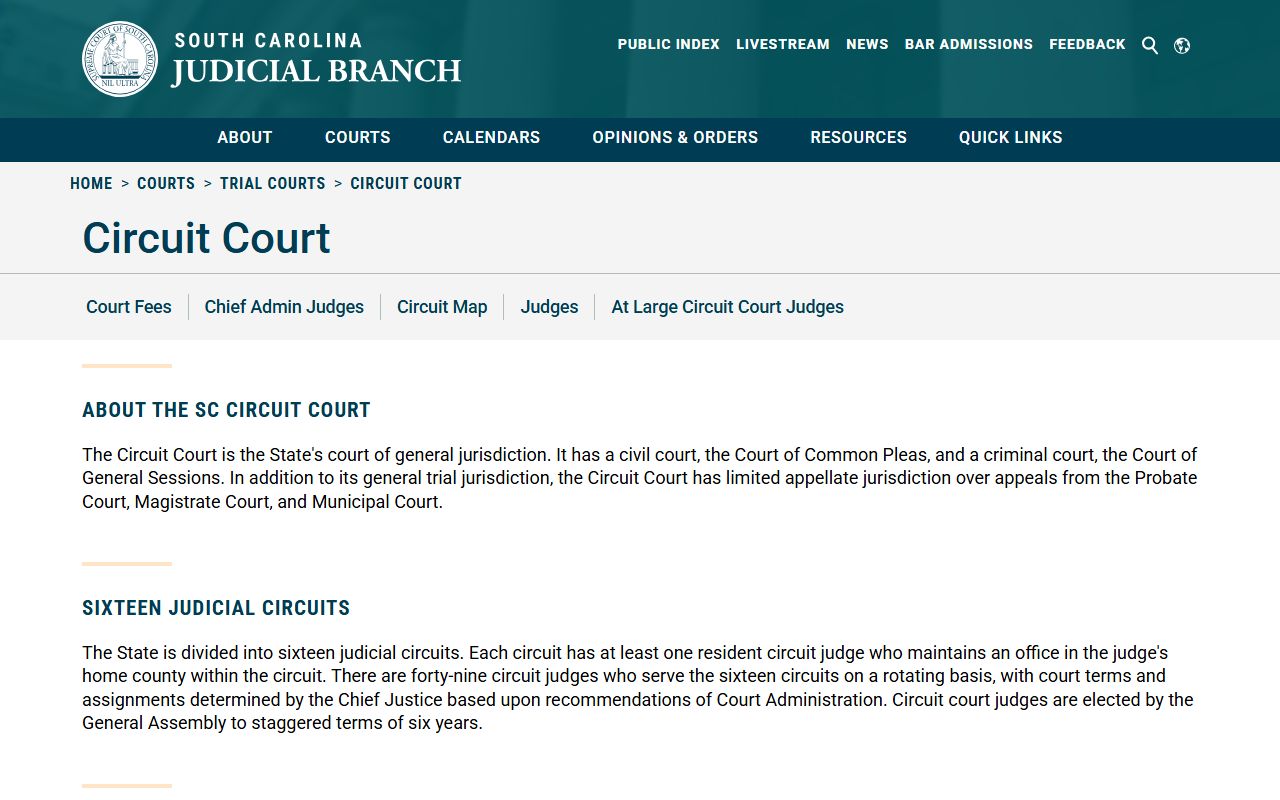
Each Circuit Court has a Clerk of Court who serves as the official record keeper and administrative officer. The Clerk maintains case files, processes filings, issues certified copies, and manages jury administration for the county. Circuit Court judges rotate among counties within their assigned circuit, which helps ensure consistent legal interpretation across South Carolina.
Circuit Court Records in South Carolina
The Circuit Court is South Carolina's court of general jurisdiction. It operates through two divisions. The Court of Common Pleas handles civil matters. The Court of General Sessions handles criminal cases. The Circuit Court also has limited appellate jurisdiction over appeals from Probate Court, Magistrate Court, and Municipal Court. Circuit Court records are among the most frequently accessed court records in South Carolina because they cover such a broad range of case types and are fully documented by record clerks.
The Court of Common Pleas handles civil cases including personal injury, contract disputes, property disputes, and matters where the amount in controversy exceeds $7,500 or where equitable relief is sought. The Court of General Sessions handles felonies and serious misdemeanors. The Circuit Court has exclusive jurisdiction over criminal cases punishable by more than one year imprisonment or fines exceeding $5,000. Certified copies of any document in a Circuit Court case file are available through the Clerk of Court in the county where the case was filed. The Clerk can search by party name or case number.
Learn more about Circuit Courts in South Carolina through the Judicial Branch website. Court fees for new Circuit Court civil filings are set by statute. Fee waivers are available for qualifying parties through an Affidavit and Application to Proceed In Forma Pauperis.
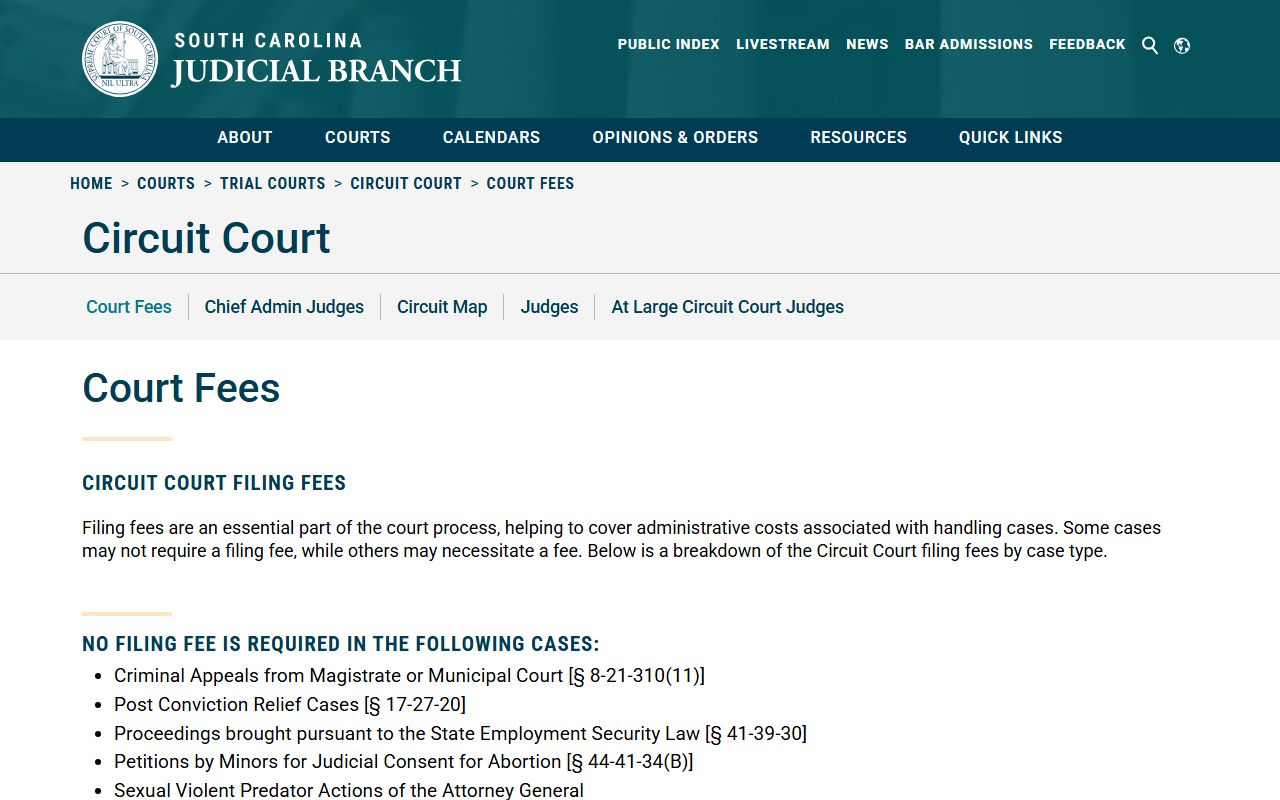
The Circuit Court fee schedule includes a $150 fee for new cases. Appeals from Magistrate Court require no filing fee for criminal matters. Copies of existing circuit court records cost per page, with certified copies priced higher. Contact your county Clerk of Court for current copy costs in South Carolina.
Family Court Records in South Carolina
The Family Court has exclusive jurisdiction over matters involving domestic or family relationships. This includes divorce, legal separation, custody, visitation, termination of parental rights, adoption, support, alimony, division of marital property, and name changes. Family Court generally has exclusive jurisdiction over minors under 18 alleged to have violated state law, with serious charges transferable to Circuit Court. Family Court records in South Carolina are maintained by the Clerk of Court in each county and are accessible through the Public Index.
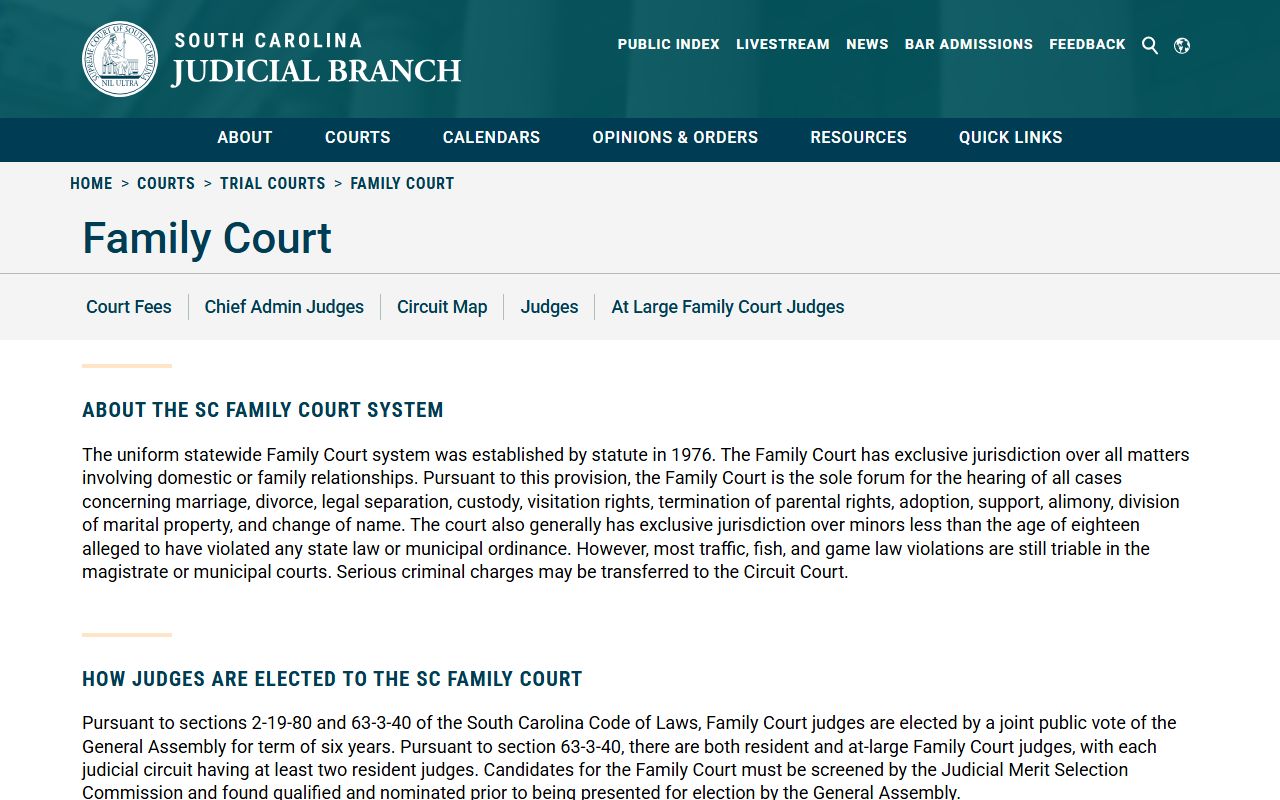
Family Court proceedings involving minors are generally confidential. Records in juvenile cases are sealed from public inspection to protect children's privacy. Domestic relations cases such as divorce, custody, and support are generally open public records. The Family Court also operates the State Disbursement Unit, which processes child support payments across South Carolina. Family Court judges are elected by joint vote of the General Assembly to six-year terms. Each judicial circuit has at least two resident Family Court judges. More information on the South Carolina Family Court system is available through the Judicial Branch site.
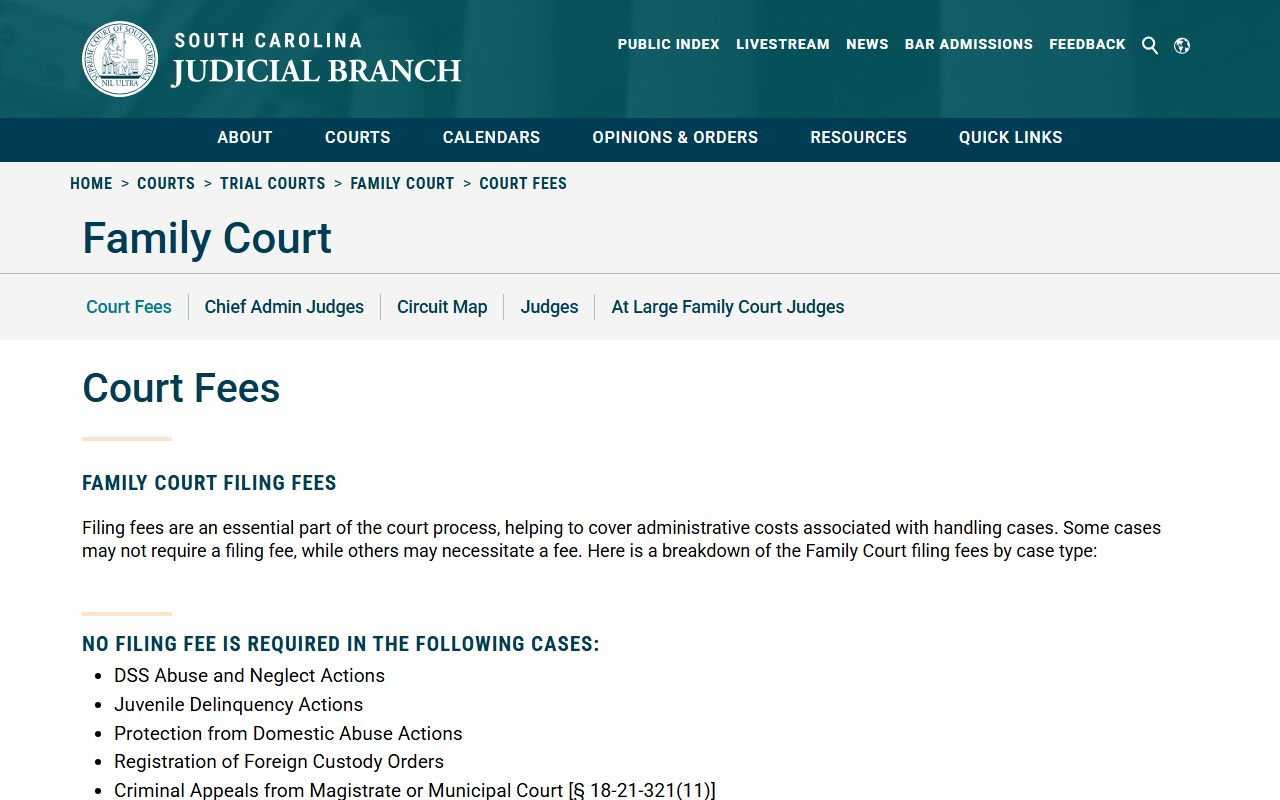
Filing fees for Family Court matters are set by statute. The Family Court fee schedule lists fees for divorce, custody, support, and adoption cases. Actions involving DSS abuse and neglect, juvenile delinquency, and protection from domestic abuse require no filing fee. Fee waivers are available for qualifying parties in South Carolina.
Magistrate Court Records in South Carolina
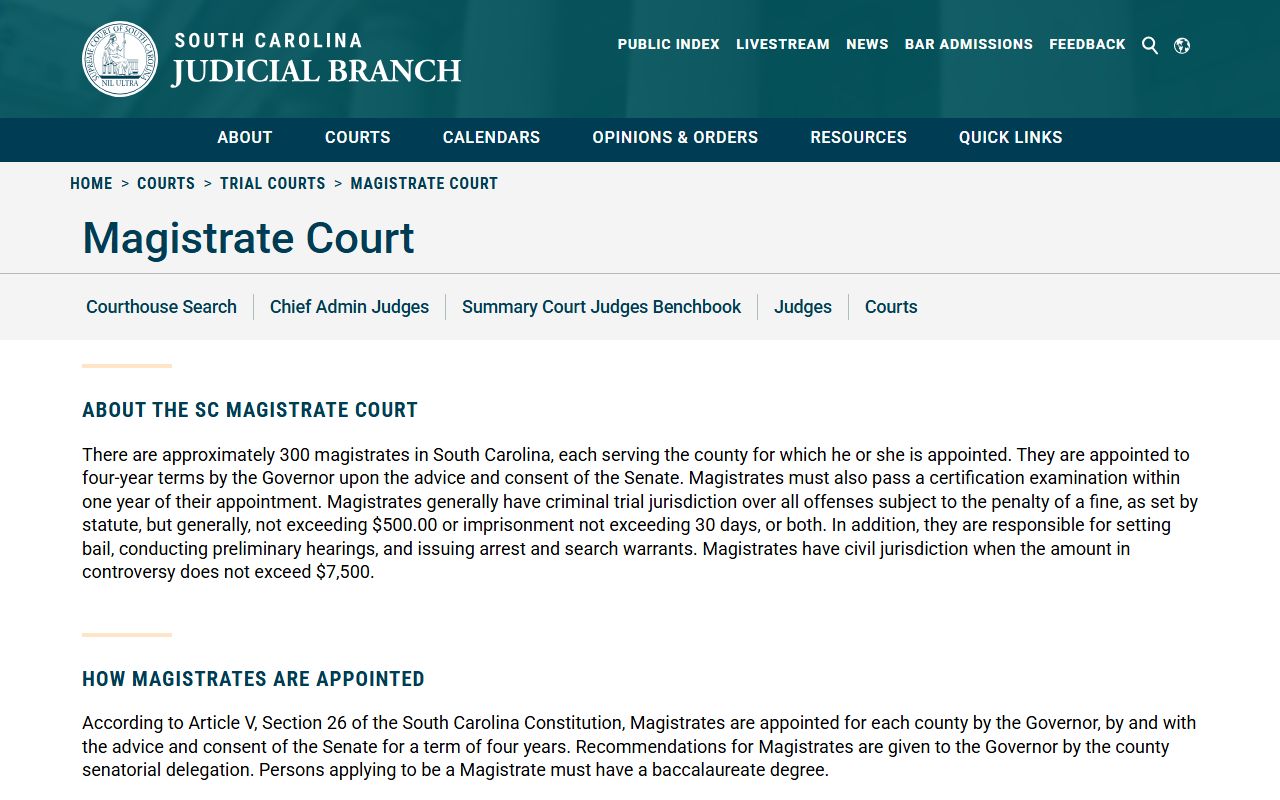
Approximately 300 magistrates serve in South Carolina, each serving the county for which they are appointed. Magistrates are appointed to four-year terms by the Governor with the advice and consent of the Senate. The Magistrate Court handles criminal offenses subject to a fine not exceeding $500 or imprisonment not exceeding 30 days. Civil cases where the amount in controversy does not exceed $7,500 are also heard at this level. These courts handle the majority of traffic violations in South Carolina, including DUI charges and speeding tickets.
Magistrate courts are courts not of record, meaning proceedings are not transcribed verbatim. Magistrates issue arrest warrants, search warrants, and bench warrants. They conduct bond hearings and preliminary hearings in felony cases to determine probable cause. Appeals from magistrate court decisions go to the Circuit Court and result in de novo trials. Magistrate court records are maintained separately from Circuit Court records and may be accessed through individual magistrate offices. Find contact information for any county through the SC Magistrate Court page.
South Carolina Municipal Court Records
Municipal Courts have jurisdiction over cases arising under city ordinances and offenses occurring within city limits that are subject to fines not exceeding $500 or imprisonment not exceeding 30 days. About 200 municipalities in South Carolina have created municipal courts. These courts have no civil jurisdiction. Their criminal jurisdiction mirrors that of magistrate courts within city limits. Under S.C. Code Ann. § 22-3-545, municipal courts may also hear cases transferred from general sessions when the penalty does not exceed one year imprisonment or a $5,000 fine, provided both the solicitor and defendant agree.
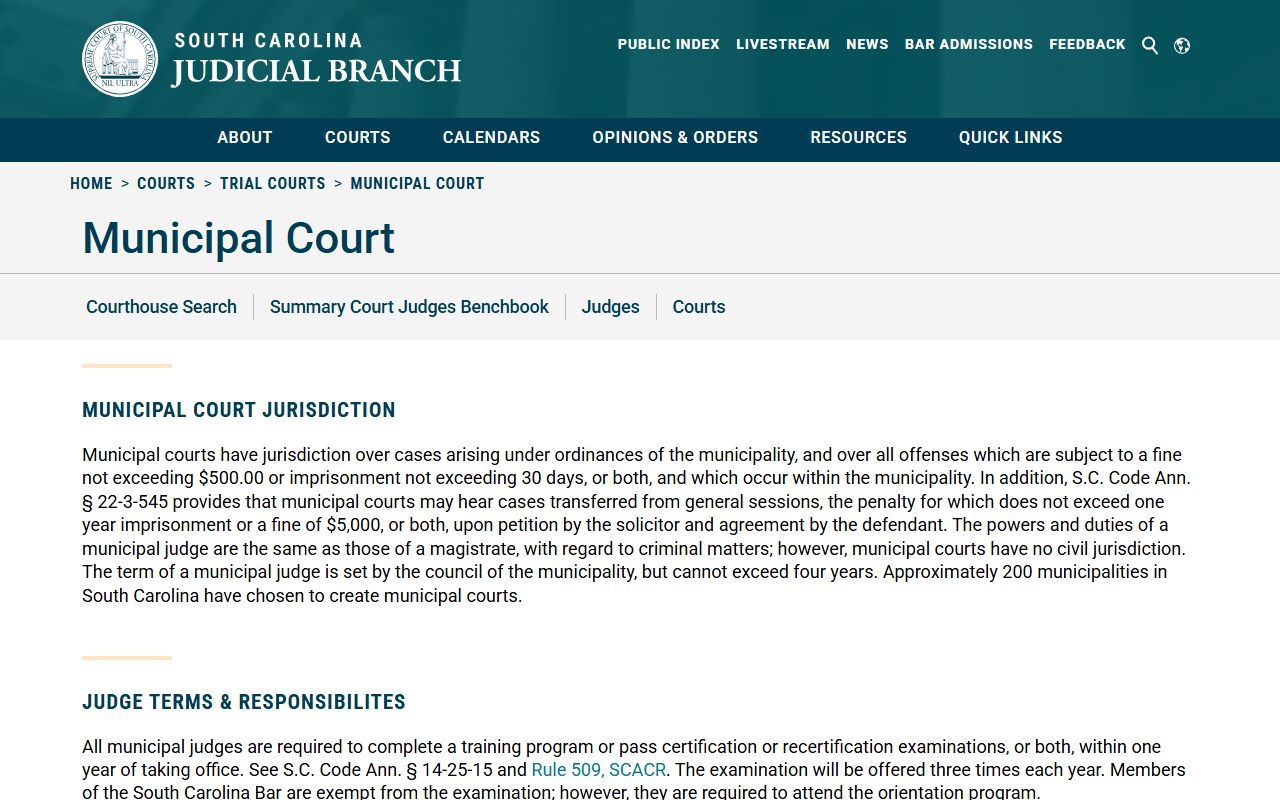
Municipal court records are maintained by each municipality and may not appear in the statewide Public Index. You must contact the individual municipal court directly for those records. Appeals from municipal court decisions go to Circuit Court and result in de novo trials. Some municipal courts operate specialized dockets including homeless court and veterans treatment court. Learn more at the SC Municipal Court page.
Note: If you need records from a city's municipal court, contact that city directly, as those records may not be in the statewide SC Public Index system.
Probate Court Records in South Carolina
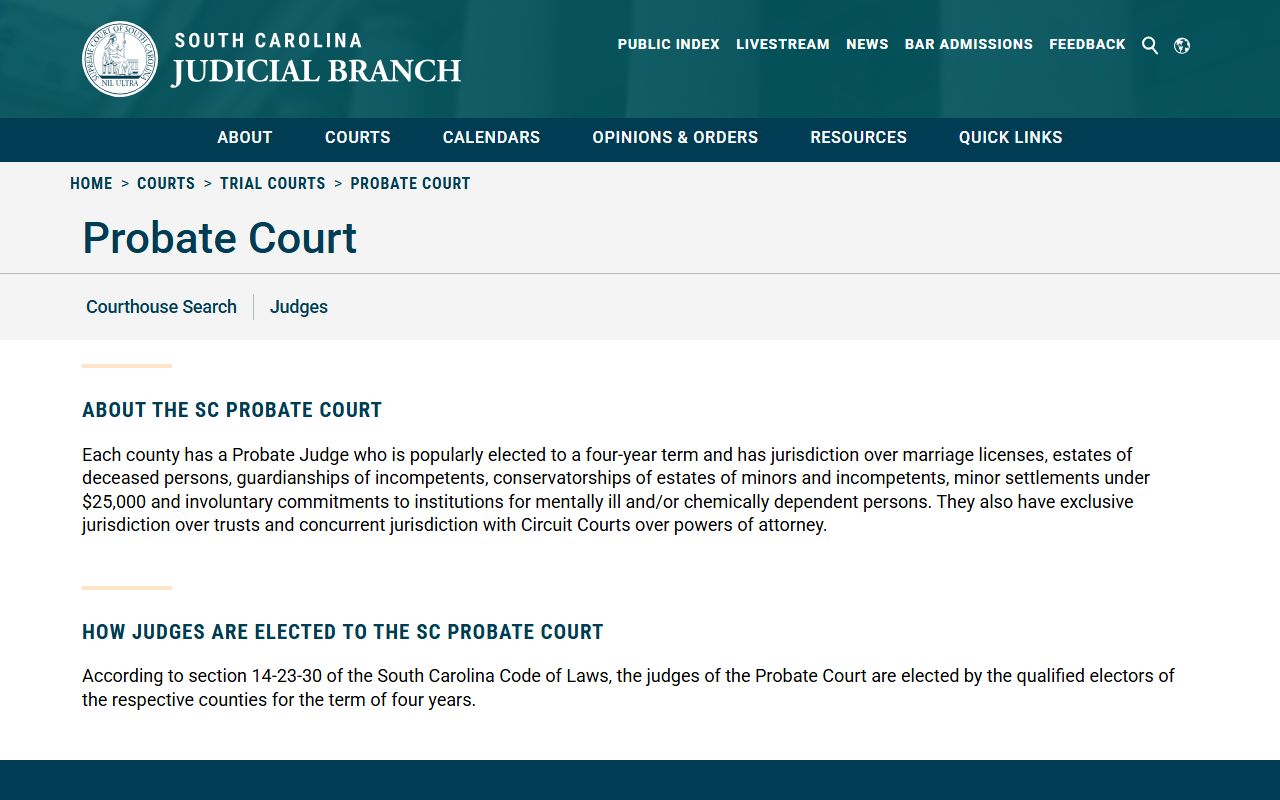
Probate Courts operate in all 46 counties of South Carolina. Each court has jurisdiction over marriage licenses, estates of deceased persons, guardianships of incompetent persons, conservatorships of minors and incompetents, minor settlements under $25,000, involuntary commitments for mentally ill or chemically dependent persons, and trusts. Probate judges are elected by county voters to four-year terms per S.C. Code Ann. § 14-23-30. Probate Court records are generally open to public inspection, with the exception of adoption records and certain sealed mental health proceedings.
The Probate Court issues marriage licenses and maintains marriage records for each county. Estate proceedings including probate of wills, administration of intestate estates, and distribution of assets are all documented in probate records. These records are valuable for legal research and genealogical purposes. Probate Court fees vary by type of proceeding and the value of assets involved. Visit the SC Probate Court page to find the probate court contact information for any county in South Carolina.
SLED Criminal History Records in South Carolina
The South Carolina Law Enforcement Division (SLED) maintains the Citizens Access To Criminal Histories system, known as CATCH. This system provides name-based criminal history information from South Carolina records only. It does not include federal criminal records or records from other states. The cost is $25 per search plus a $1.00 convenience fee for online transactions. You must provide the full name including maiden name if applicable, date of birth, and social security number for accurate results.
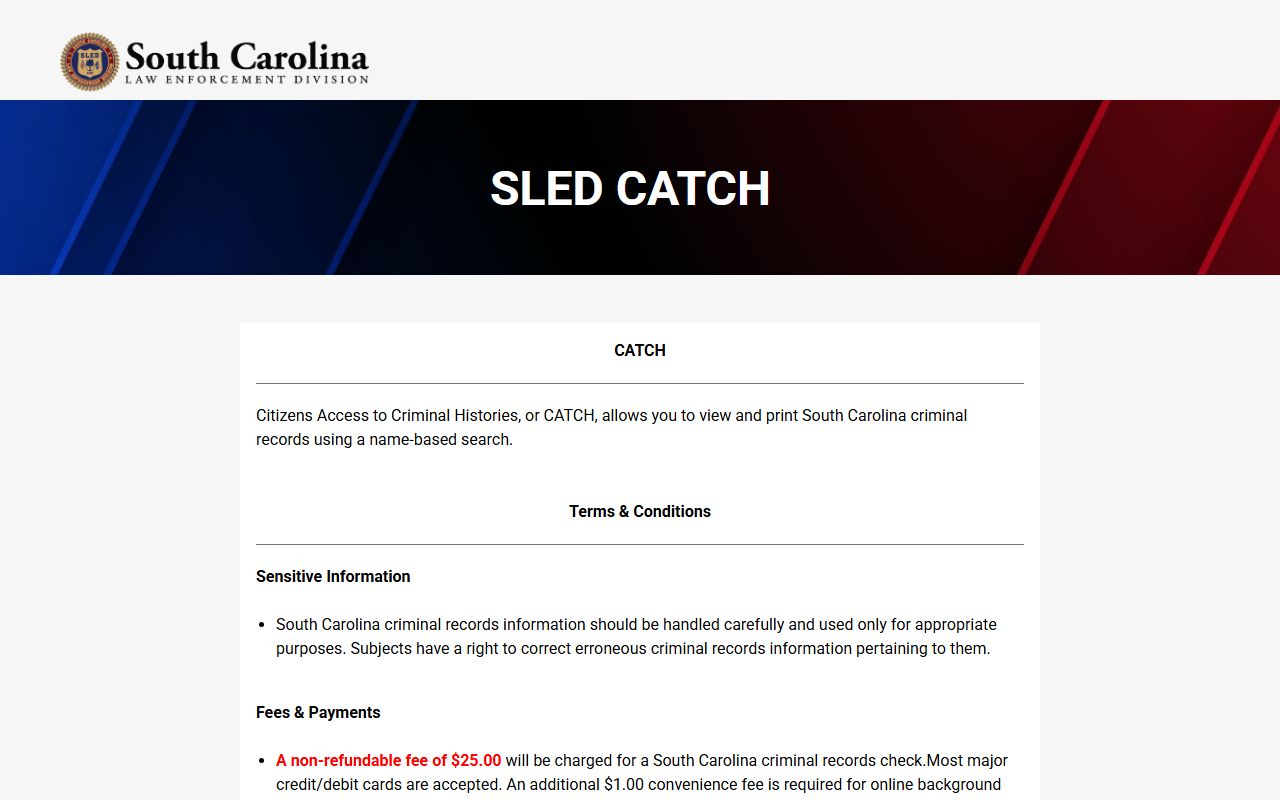
CATCH results include arrest records, conviction records, disposition information, and incarceration data from South Carolina jurisdictions. Online searches provide immediate results, and the system is available 24 hours a day. Juvenile records, sealed records, and expunged records are not available through CATCH. Fingerprint-based background checks are available for more thorough identity verification. Access the system at catch.sled.sc.gov or contact the SLED Records Department at (803) 737-9000.
Note: CATCH covers South Carolina records only and is not a substitute for a full national criminal history check.
South Carolina Open Records and FOIA
South Carolina's Freedom of Information Act gives the public the right to inspect, copy, or receive electronic transmission of any public record. The General Assembly stated in § 30-4-15 that it is vital in a democratic society that public business be performed in an open manner so that citizens can be advised of the decisions that are reached in public activity. This right applies to court records held by public bodies. It does not extend to individuals currently serving sentences of imprisonment in state, county, or federal correctional facilities.
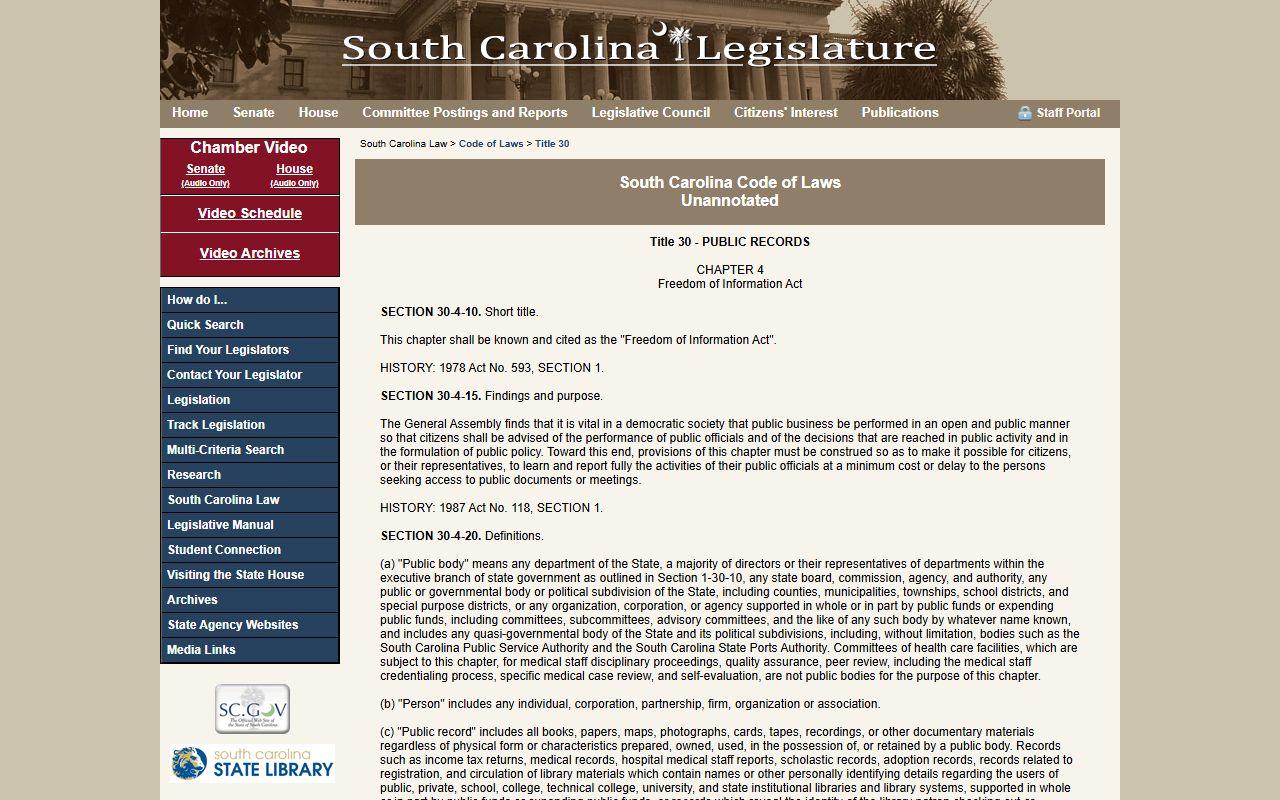
Public bodies must respond to FOIA requests within 10 days for standard records, and within 20 days for records more than 24 months old. If granted, records must be furnished within 30 calendar days from the final determination. Failure to respond within those timeframes is treated as automatic approval for nonexempt records. Fees for records cannot exceed actual costs of search, retrieval, and redaction, and copy fees may not exceed the prevailing commercial rate. Courts can order disclosure and award attorney fees to petitioners who prevail in FOIA disputes. The full framework is in Title 30 of the South Carolina Code of Laws.
Court dockets are available through each county's public index website. Filed discovery documents, trial exhibits admitted into evidence, and settlement records are all public unless sealed by court order. According to the Reporters Committee for Freedom of the Press Open Courts Compendium for South Carolina, the common law and First Amendment provide presumptive access to judicial proceedings and records. A record does not become public until it is filed with a court or signed by a judge.
South Carolina Appellate Court Records
The South Carolina Appellate Court Public Index, known as C-Track, provides public access to the Appellate Court Case Management System. It covers cases filed with the Supreme Court and the Court of Appeals. Case types available include appeals from the Court of Common Pleas, appeals from the Court of General Sessions, appeals from Administrative Tribunals, certiorari proceedings, and Post-Conviction Relief cases. Under S.C. Code Ann. § 14-8-240, appellate court records in South Carolina are open to public inspection at all times.
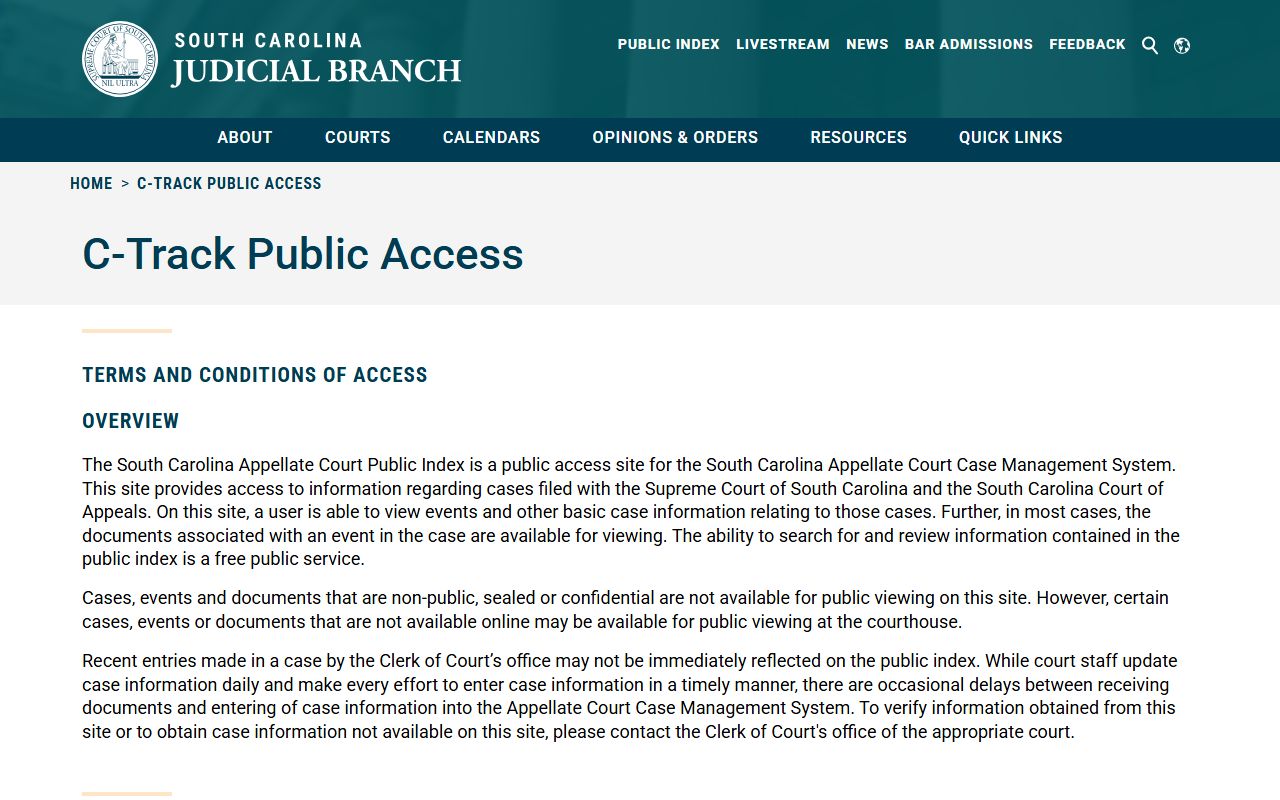
C-Track allows searching by case number, party name, or attorney. Users can view events, basic case information, and documents associated with case events. Information is generally available for cases pending or filed on or after May 1, 2012. Events prior to that date are not available through the system. Published and unpublished opinions of the Supreme Court and Court of Appeals are accessible at no charge. Access C-Track at sccourts.org/c-track-public-access.
Note: The SC Judicial Branch does not assume liability for inaccurate or delayed data on the Public Index or C-Track, and information should not be relied upon as an official record of action in any proceeding.
Browse South Carolina Court Records by County
Each county in South Carolina has its own Clerk of Court who keeps court records. Pick a county below to find local contact information, court resources, and record access details for that area.
Court Records in Major South Carolina Cities
Residents of major cities access court records through their county courthouse or local municipal court. Pick a city below to learn about court records in that area.